
Structure Every Document. Find Anything Instantly.
Classify documents with custom classes and properties, organise them in a logical hierarchy, and let naming templates keep your filing consistent, so the right information is always exactly where you expect it.
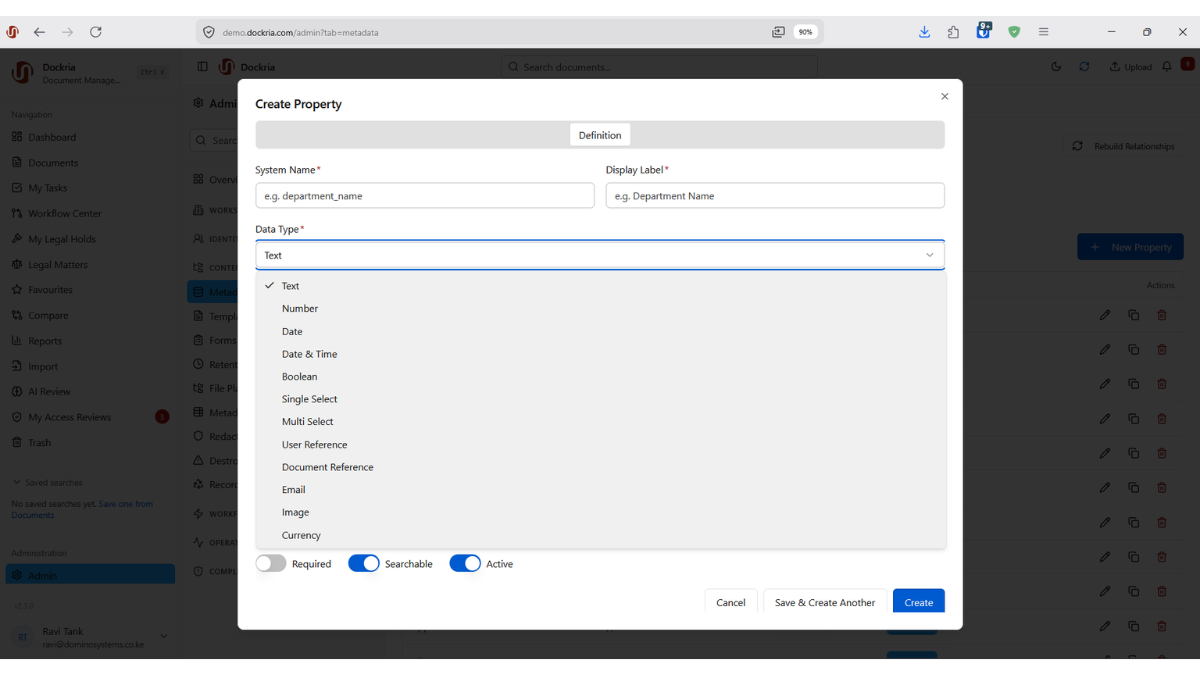
Unstructured document stores quickly become unusable. When every team names and files documents their own way, finding the right record turns into a treasure hunt. Dockria's Metadata Management gives your organisation a single, structured classification model so that every document is captured with the right information from the moment it enters the system.
Metadata properties are the individual data fields you attach to documents: a contract value, a case number, a patient identifier, an expiry date. Each property has a defined data type and can be marked as required, searchable, or unique, with optional typeahead suggestions drawn from existing values so data entry stays clean and consistent across thousands of documents.
Document classes are the categories that group your documents and determine which properties apply to each. A 'Contract' class might carry counterparty, value, and renewal-date fields, while an 'Invoice' class carries supplier, amount, and due-date fields. Each class has its own icon, colour, and configuration, and can require a change reason whenever its documents are edited.
Classes can be organised into a parent–child hierarchy, so related categories sit neatly beneath a common parent while remaining independently configurable. Rules defined on a parent class, such as automatically linking documents that share a case number, are inherited by every child class beneath it, reducing setup effort and guaranteeing consistent behaviour. Naming templates then generate standardised document titles automatically from your metadata, so your repository stays orderly without manual effort.
Key Benefits
Custom Properties
Define data fields of any type and flag them as required, searchable, or unique, with typeahead suggestions that keep data entry clean and consistent.
Document Classes
Group documents into configurable categories, each with its own icon, colour, and the exact set of properties relevant to that document type.
Class Hierarchy
Organise classes into parent–child structures so related categories stay grouped while each child class remains independently configurable.
Inherited Rules
Rules set on a parent class automatically apply to every child class, so consistent behaviour is guaranteed without duplicating configuration.
Automatic Naming Templates
Generate standardised document titles from metadata fields, keeping your repository orderly with zero manual renaming.
Searchable & Structured
Because every document is classified and tagged, search and filtering become fast, precise, and reliable across your entire archive.
Industry Use Cases
Law firms classify matters, contracts, and court filings with case numbers and parties, then link related documents automatically through inherited rules.
Hospitals structure patient records, consent forms, and lab results with consistent identifiers, making any record retrievable in seconds.
Banks tag loan files, KYC documents, and transaction records with searchable metadata for instant retrieval during audits and reviews.
Ministries organise correspondence, permits, and records into structured classes that mirror their official filing schemes.
Related Features
See How This Feature Applies to Your Industry
Ready to see metadata management & classification in action?
Schedule a personalised demo and discover how Dockria can transform your document management operations.
Request a Demo